Kirkus Star Houdini Books: 2 Women Make History
Kirkus Star Houdini books made publishing history in 2026 when two new titles about Harry Houdini received the coveted Kirkus Star, and both were written by women. One book explores how reading helped shape the world’s greatest magician. The other reopens the forensic questions surrounding Harry Houdini’s death.
Together, Houdini’s Library by Barb Rosenstock and Houdini: The Man Who Died Twice by Larrian Gillespie, M.D., show how much room remains for fresh Houdini scholarship, biography, children’s literature, and historical investigation.
Two Kirkus Star Houdini books in one year
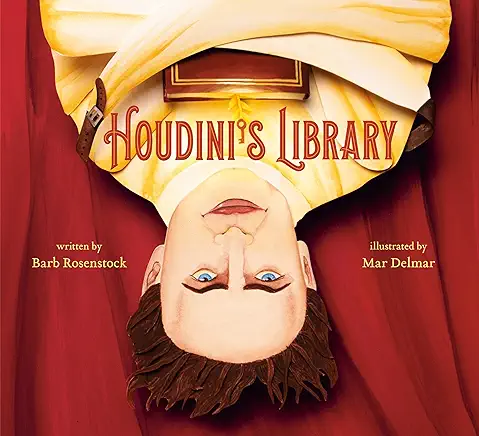
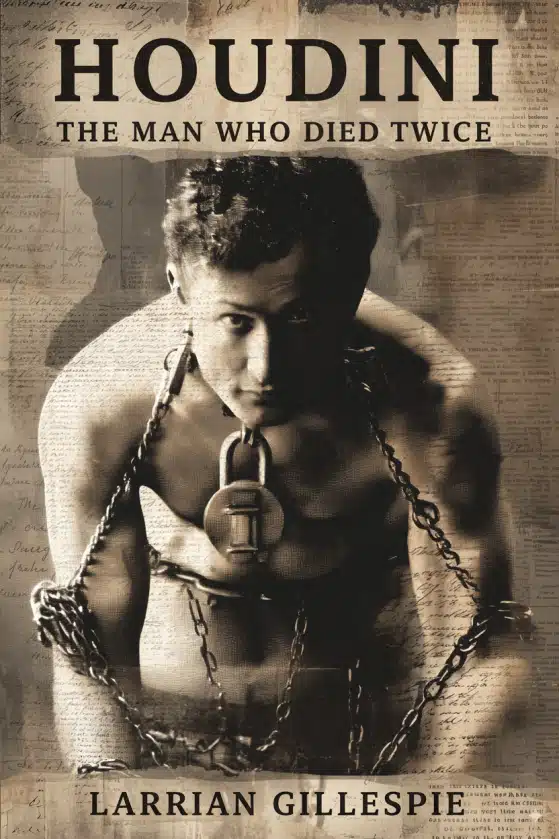
Barb Rosenstock’s HOUDINI’S LIBRARY: HOW BOOKS CREATED THE WORLD’S GREATEST MAGICIAN, illustrated by Mar Delmar and published by Knopf, tells young readers how books helped shape Houdini’s life. My HOUDINI: THE MAN WHO DIED TWICE, published by Cipher House Books, reexamines the medical and documentary record surrounding Houdini’s death.
One Houdini book begins with a library. The other begins with a death certificate. Somehow, in the same year, Kirkus noticed both.
Barb Rosenstock’s Houdini’s Library earns four starred reviews
When I wrote to Rosenstock on May 2 to congratulate her, she replied with news that made the achievement even more striking.
“Houdini’s Library now has 4 (FOUR!) starred reviews,” she wrote, “but you’re right in that the Kirkus one is the ‘hardest’ to get!”
Those starred reviews came from Kirkus, Publishers Weekly, School Library Journal, and Booklist. For a picture-book biography, that is an extraordinary reception. It also proves that Houdini is still not done surprising people. The subject is bigger than magic apparatus, auction catalogs, and performance history.
Why Houdini still reaches young readers
Rosenstock suggested that readers often want to know how or why she became interested in Houdini, what surprised her most in the research, what sources proved most helpful, and why HOUDINI’S LIBRARY should be read by children. Her answer to the first question came with a wonderful aside: she became interested in Houdini “around 10!”
That sounded familiar. Houdini has a way of finding people early. A child hears the name and does not need a lecture on vaudeville, spiritualism, or showmanship. Houdini means escape, and children understand escape.
Rosenstock’s own childhood gave her another doorway into the past. She was born in Chicago, the oldest of three, and grew up in the far southwest suburbs when the area was still close to farmland. Her mother was “a huge reader,” and the weekly trip to the library was part of family life.
“There were no rules to our reading,” Rosenstock said. “We took out what we liked, period.”
She also credits her maternal grandfather, “a gifted natural storyteller,” with feeding her interest in earlier lives. He told stories about his childhood, immigrant parents, and the Great Depression. As Rosenstock grew older, she would bike into town, visit the library, and stop at an antique store housed in an old general store.
“I liked thinking about the people who inhabited the place before me,” she said. “In a way I have always felt like I understood the past more than the present.”
That sense of the past runs through HOUDINI’S LIBRARY. Rosenstock does not begin with the usual Houdini spectacle. She begins with a boy and his hunger for books, then follows how that hunger became research, discipline, ambition, and performance.
The book’s visual world is just as striking. Rosenstock is quick to say she is not an art expert. Her college major was psychology, and her first career was in corporate design and marketing, where graphic designers taught her how to look at pages, typefaces, images, and balance.
“I learned visual balance, surprise touches, and how much art and words can communicate together,” she said.
Picture-book authors, she noted, do not usually choose their illustrators. Publishers do. In this case, the pairing with Mar Delmar produced a book whose cut-paper and gouache illustrations feel dimensional and theatrical, as if Houdini’s world has been built inside a miniature stage.
The most difficult part of bringing Houdini’s library to children, Rosenstock said, was structure. A straight chronological opening with Harry/Erik as a child felt flat.
“I mean why should kids care about this little guy and his books?” she said.
Her solution was to begin with the adult Houdini, famous and surrounded by books, and then move backward to show how those books helped create him. The book works because reading is not background decoration. It is the engine.
Rosenstock does not collect books the way Houdini did. Her office fills with research books on whatever subject she is working on, but after publication she often gives them away to make room for the next project. The exception is children’s books. She keeps hundreds of them, including books by friends, books that inspire her, and books from her own childhood.
Her favorite author since third grade is Maud Hart Lovelace, author of the Betsy-Tacy books. Rosenstock tries to reread at least one each year.
“If I had Houdini’s house,” she said, “I’d make room for more.”
When I asked which single book she would want from Houdini’s library, she did not choose the oldest or most valuable volume. She chose the one with the strangest title: MY EXPERIENCE WHILE OUT OF MY BODY AND MY RETURN AFTER MANY DAYS, by Cora Richmond, a famed medium who signed and presented the book to Houdini around 1910.
Her choice has a marvelous side connection to Rosenstock’s earlier young adult book, AMERICAN SPIRITS, about the Fox Sisters. She said she would ask Houdini for Richmond’s book and whether he could perform a “rapping” seance like the ones that made the Fox Sisters famous.
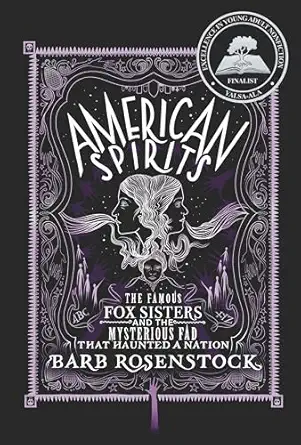
“I’d love to attend one,” she said.
I also asked what she would ask Houdini if she could speak to him as a fourth grader. Technically, she noted, the boy who became Houdini had to work and did not remain in school as a fourth grader.
“At that age, I think his life was rough enough,” she said. “He probably wouldn’t need questions from me or anyone else. I think I’d just let him be a kid and make sure he knew that everything was going to turn out pretty good for him.”
That is Rosenstock’s Houdini: full of wonder, but still a child beneath the legend.
Why these Houdini books matter in 2026
Our two Houdini books could hardly be more different, yet they sit side by side in this one curious 2026 moment. Rosenstock entered through children’s literature, research, visual storytelling, and the power of reading. I entered through medicine, timelines, and the contradictions in Houdini’s death record. Neither of us approached him as a magician. Neither of us wrote the expected Houdini book.
For Rosenstock, the question was: how did books create Houdini?
For me, the question was: what really happened to Houdini?
The answers belong on different shelves, but the 2026 Kirkus Stars connect them. Houdini is not finished with us yet.
Two women asked their own questions in 2026.
Houdini, once again, escaped the box, covered in six stars!
Frequently asked questions about the 2026 Kirkus Star Houdini books
Which Houdini books won Kirkus Stars in 2026?
The two Kirkus Star Houdini books discussed here are Houdini’s Library: How Books Created the World’s Greatest Magician by Barb Rosenstock, illustrated by Mar Delmar, and Houdini: The Man Who Died Twice by Larrian Gillespie, M.D.
Why is this important for Houdini readers?
These books approach Harry Houdini from two different directions: children’s biography and forensic historical investigation. Together, they show that Houdini’s story still supports new research, new audiences, and new questions nearly a century after his death.
How significant is it to receive a Kirkus Star?
A Kirkus Star is highly significant because Kirkus describes it as one of the book industry’s most coveted designations and reserves it for books of exceptional merit. For a Houdini title, that recognition signals that the book stands out beyond ordinary coverage and has earned unusually strong critical notice.
Have any books on Houdini ever won a Kirkus Star besides Houdini’s Library and Houdini: The Man Who Died Twice?
In the Kirkus records I found, the Houdini-focused books with Kirkus Stars are Houdini’s Library: How Books Created the World’s Greatest Magician by Barb Rosenstock, illustrated by Mar Delmar, and Houdini: The Man Who Died Twice by Larrian Gillespie, M.D. I did not find another Houdini-centered book with a Kirkus Star, which makes the 2026 pairing especially notable.
Where can readers find more Houdini research?
Readers can explore more Houdini history through Houdini Articles, watch archival material in Houdini Videos, and learn more about Houdini: The Man Who Died Twice.